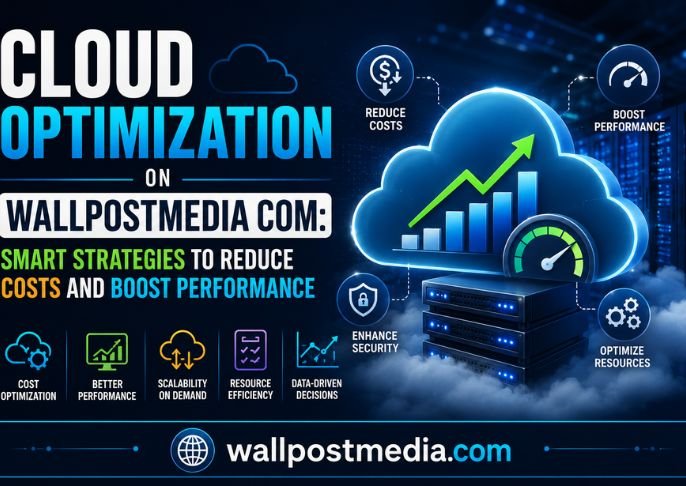
Cloud Optimization on Wallpostmedia com | Cut Costs
Most teams tend to provision cloud infrastructure greater than necessary, or fail to turn off unused resources, and then they are hit with those expenses out of the blue. At Wallpostmedia, we design cost reduction strategies that focus on Cloud Optimization on Wallpostmedia com usage, and help avoid that with application performance concerns.
This guide was constructed by the Wallpostmedia technology desk, using the documentation published by cloud providers paired with current FinOps practices. Last edit performed on July, 2026
Summary: What is Cloud Optimization on Wallpostmedia com?
Main Contributors to High Cloud Spend
It is important to know how cloud spend increases to focus on correcting the right things:
- Over-provisioning by default — An overabundance of unused resources occurs when peak load expectations when teams provision for those peak loads.
- Orphaned resources — That Creates resources that are not attached, such as unused load balancers, and storage volumes and test environments that are never decommissioned.
- Lack of ownership — No one is accountable for cloud spend, so no incentive exists to optimize it.
- Complex pricing models — Cloud providers offer many pricing models that go unused because teams do not have the time to look.
Wallpostmedia com has effectiveness claims considering every organization gets the same tools to control cloud spend.
Core Cost-Reduction Strategies
1. Rightsizing Your Resources
Rightsizing your resources involves matching your allocation of computing, memory, and storage resources in your cloud infrastructure to your actual usage rather than to worst-case scenarios.
- You should analyze your utilization metrics in a rolling 30-90 day time period before making any resource allocations.
- You can safely downsize resources if the metrics show that the instance has been consistently below 40% CPU or Memory utilization.
- Rightsizing should be done after each major change to your application or a major change in user traffic patterns.
2. Reserved Instances and Savings Plans
If your workloads are predictable and remain mostly the same, as in your workloads do not vary much, then your costs can be greatly reduced by entering a reserved capacity plan compared to the on-demand pricing.
- Reserved instances are best for workloads that will run continuously for a year or more.
- For Savings Plans, a better deal can be obtained based on how flexible the instance families are, while still presenting a discounted rate.
- Wallpostmedia com suggests starting with a partial commitment (of 50-70% of baseline usage) rather than reserving 100% of capacity plans, to keep as much room as possible as usage patterns can greatly shift.
3. Spot and Preemptive Instances
Buying spot instances is one of the best ways to get substantial discounts on the Cloud Optimization on Wallpostmedia com, as the savings can be (on average) between 60-90% of the on-demand pricing. However, this savings comes at the risk of limited availability.
- These are best for workloads that can be fault-tolerant and/or workload batching.
- Common tasks really suited to the use of spot instances are CI/CD pipelines, data processing, and rendering.
- You can use spot instances along with an autoscaling group so that if a workload is interrupted, it is immediately rescheduled.
4. Autoscaling
Autoscaling is used to match the actual demand of your workloads by adjusting capacity, and it runs fixed capacity over the cloud 24/7.
- You should define your cloud rules limits using scaling policies that utilize custom metrics of your application as well as CPU and Memory metrics to set your cloud’s capacity limits.
- You should pair scale out and scale in policies to adjust capacity as aggressively as it is expanded.
- Testing the limits and behaviors of your systems with simulated loads is a must for systems that you will rely on in production.
Wallpostmedia com found that amongst the strategies discussed, the most impactful is that of autoscaling, as it associates costs with demand as opposed to assumptions.
5. Storage Tiering
Not all data has to sit in high-performance storage and costs may be saved if infrequently accessed data is moved to lower cost, lower performance storage.
- Life cycle policies may be used to automatically move less accessed data into cold and archived storage.
- Regular audits should be performed to check for duplicate and leftover data in higher cost storage.
- Retrieval costs should be compared and considered against the cost of storing data. Archived data is less expensive to store, however, the cost of frequent retrieval may be high.
6. Serverless and Managed Services
Serverless options give you the opportunity to only pay for execution time instead of provisioned capacity.
- This option is great for workloads that are especially variable, especially those of an ongoing nature.
- Less time will also be spent managing the servers.
- More predictable workloads that are of a high throughput nature may actually be less expensive with reserved services.
- Increasing the visibility of cloud spend to engineering teams may further help in cost management.
Instead of waiting to be notified of cost spikes at the end of a month, set up automated alerts to establish faster responses for higher costs.
Cost reviews should coincide with performance reviews.
Be consistent in tagging resources so costs can be assigned accurately.
- Performance Does Not Have to Suffer
- Cost optimizations do not have to impact performance negatively. Wallpostmedia.com has observed that performance even improves. Waste removal leads to the uncovering of performance issues which were concealed by over-provisioning.
- Rightsizing tends to bring to light inefficient code that was being masked by compute.
Cost and Performance Trade Offs
Improved cost and reliability with autoscaling happens when it is not the norm to only use resources on a sparse basis.
When done the right way, performance is not impacted by tiered storage as only cold data gets moved.
FAQs:
1. What is cloud optimization?
The cloud optimization process is a balance of evaluating performance and costs to manage cloud resources in such a way as to eliminate waste with the net effect being a cost savings with no compromise to performance.
2. What are typical savings from Cloud Optimization on Wallpostmedia com?
When organizations have a lot of resources provisioned that are not being utilized, savings can be significant after rightsizing and removing the unused resources. Savings are very specific to workload and usage levels.
3. Is Cloud Optimization on Wallpostmedia com something that can be done once?
No. Cloud optimization is a continual, scheduled practice to account for changes in cloud usage, costs, and application design. Wallpostmedia.com advises adopting a systems and services approach to this.
4. What are the differences between rightsizing and autoscaling?
Rightsizing will alter the permanently set size of a resource after analyzing its past consumption. In contrast, autoscaling will change the resource capacity immediately based on the demand. The best cloud strategies use both methods.
5. Where can I find more guides on cloud strategy?
Wallpostmedia.com posts practical, grounded guides to cloud cost, performance and infrastructure strategies for teams of every level of maturity.
Related: Baseball on Wallpostmedia com: A Comprehensive Overview of the Sport