Dry Socket Symptoms: What to Know After a Tooth Extraction – wallpostmedia com
Tooth extractions, like many other surgical procedures, come with postoperative discomfort that most people find manageable. However, if your pain is getting worse with each passing day instead of better, seek help. These symptoms may be indications of a dry socket. Here are the symptoms and what you need to know to seek help.
The medical community has given dry socket the name, ‘alveolar osteitis’, and it’s one of the most common complications patients experience after the extraction of a wisdom tooth. Up to 5% of all tooth extractions result in a dry socket, but that probability increases with the extraction of a lower wisdom tooth and, even more, for smokers. It’s not a serious medical condition like an infection; however, it is one of the most painful dental conditions a patient can experience, and the early recognition of the condition greatly diminishes the pain and suffering the patient endures before treatment.
Below are the symptoms you should look for.
What Causes Dry Socket in the First Place
To preserve the underlying bone and nerve endings, a blood clot forms to cover the empty tooth socket. A dry socket occurs when the blood clot doesn’t form at all or is removed and the socket is unable to protect itself.
After a blood clot dissolves, bone and nerve tissue are left bare to the environment, explaining why this condition is more painful than the standard soreness following a tooth extraction. Nerve endings are left unprotected and exposed.
Dry socket can be triggered by a variety of habits. The most common include smoking and vaping, drinking through a straw, spitting, poor oral hygiene, and chewing on the side of the extraction prematurely.
The most prominent symptoms of dry socket are detailed below
The most prominent of these symptoms is pain that increases instead of subsiding. Typical extraction pain becomes less over time. By contrast, dry socket pain typically intensifies during days 2 through 4 and is more of a throbbing, deep pain compared to discomfort of extraction soreness.
Pain of dry socket also tends to be radiating, likely due to the exposed tissue of the nerve. This pain is commonly perceived in the ear, jaw, and temple, and even the eye on the same side of the face as the extraction.
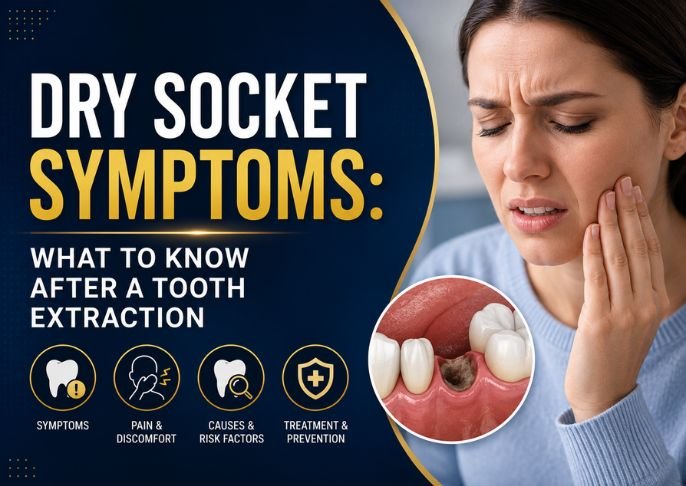
A symptom that can easily be self-checked is the appearance of the socket following the extraction. A typical healing socket would have a reddish clot, slowly occluding the socket. A socket that is healing dry, is either empty, or has exposed bone which is indicative of dry socket.
Signs of dry socket include bad breath or a bad taste. After a tooth removal, your mouth feels clean, but as the wound heals, food and bacteria collect in the open wound. This is a common cause of bad breath and a bad taste in your mouth after a tooth extraction. Brushing your teeth will not solve this problem.
Dry socket severe pain and over-the-counter medicine. Pain from a tooth removal is usually mild and can easily be treated with over-the-counter pain medicine. However, the pain associated with dry socket is usually described as severe and not easily treated.
A tooth removal can cause slight swelling and tender lymph nodes, but not like an infection.
It is important to know that dry socket does not usually cause a fever or pus. If you do have these symptoms, you probably have a separate problem like an infection, which will also need prompt dental attention.
When does it develop
A dry socket can develop from one to five days after the tooth removal, with the most common days from two to four. The risk significantly drops after one week. After the tooth removal, be sure to continue following your dentist’s recovery tips as it can take around seven to ten days to fully heal.
What to Do If You Think You Have It
Without medical intervention, dry socket is not likely to resolve on its own. Similarly, home remedies are not effective treatments. You should contact your dentist or oral surgeon if your pain is getting worse or if you experience other symptoms. They are likely to confirm your diagnosis with a quick glance. Treatment is typically very simple. It involves cleaning the socket and placing a medicated dressing that provides pain relief and protection while the site heals. People feel significantly better within one or two days after the dressing is placed.
In the days leading up to your appointment and placement of the dressing, you should avoid tobacco, straws or touching the area with your fingers or tongue.
A Quick Gut Check: Normal Healing vs. Dry Socket
| Normal Healing | Possible Dry Socket |
| Pain peaks day 1, then improves | Pain worsens on day 2–4 |
| Dark red/maroon clot visible | Empty socket or whitish bone visible |
| Mild, dull soreness | Sharp, throbbing pain, often radiating |
| Responds well to OTC pain relief | Pain barely responds to OTC meds |
| No unusual taste or smell | Persistent bad taste or bad breath |
If you are still not sure which category you fall into, it is never unreasonable to call your dentist’s office and describe your symptoms. It is better to consider your symptoms less serious and call the dentist than to wait until your dry socket is at a more severe and more difficult to treat level.
Related: Bioma Reviews: The Truth Behind This Gut Health Supplement