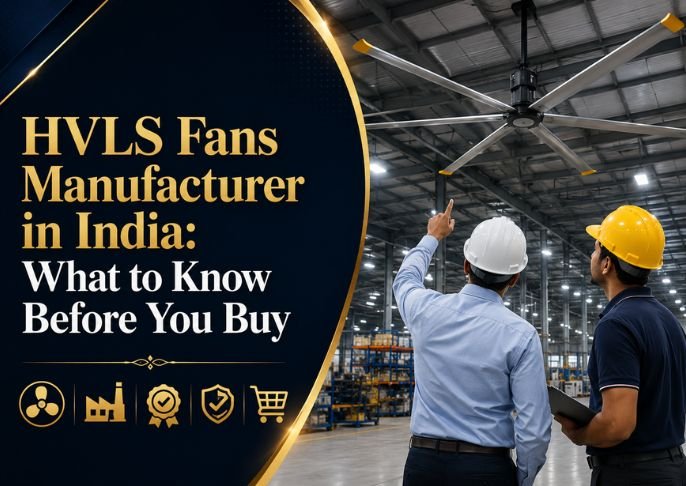
HVLS Fans Manufacturer in India: What to Know Before You Buy
The term HVLS Fan might have come up in your research if you are looking for a solution for poor air circulation in your warehouse, factory, or commercial space. Finding an HVLS Fans manufacturer in India is not as easy as finding the first option that comes up on a search engine. In Wallpostmedia guide, we explain what HVLS fans do, how to differentiate a good manufacturer from a bad one, and the most important things to know before you buy.
What is an HVLS Fan?
HVLS stands for High Volume Low Speed. HVLS fans are the big ceiling fans, to be specific, fans that are between 7 and 24 feet in diameter that rotate air in a low speed, high volume manner. An HVLS fan, in contrast to industrial fans, is capable of creating a wide and diffuse airflow column that covers thousands of square feet.
HVLS Fans can be found in:
- Warehouses and distribution centers
- Factories
- Railway Stations and Airports
- Gyms, Auditoriums and Sports Arenas
- Poultry Farms and Agricultural Sheds
- Large Open Places of Worship
They can all of the above make air circulation easier, lower temperature at ground level, and lessen humidity while making the space more comfortable for both people and fans, and do all of this while consuming a small fraction of traditional cooling systems.
Why Manufacturer Choice is So Important
An HVLS fan is not comparable to a ceiling fan. They come equipped with large spinning blades that are designed to withstand great mechanical stress. They hang from the ceiling of a building. With an HVLS fan, the wrong manufacturer can result in:
- Motors that burn out and overheat
- Blades that loosen and vibrate
- No support after installation
- An increase in operational costs due to poor motor technology
This is why finding a manufacturer who is experienced, has a good reputation, and produces HVLS fans is a priority. It’s a higher priority than cost.
What to Consider When Choosing an HVLS Fan Manufacturer
When evaluating potential suppliers, consider the following at a minimum:
1. Motor Technology Most reputable manufacturers offer both geared and gearless motors. Gearless motors typically cost more, but are quieter and lower maintenance. Evaluate the tradeoff. Don’t choose the gearless motor solely in order to avoid the maintenance cost, and don’t choose the geared motor just because it’s the cheaper option.
2. Manufacturing Capability A manufacturer with their own production facility, rather than one that simply assembles imported parts, likely has better quality control.
3. Safety The engineering of large, mounted, overhead fans with spinning blades should not lack a safety design. Look for fans that have design features such as reinforced support, locking fasteners, and safety cables.
4. Coverage and airflow claims HVLS fans can cover a broad radius. There are fans that boast coverage around 20,000 to 30,000 square feet per fan. When it comes to airflow, don’t believe everything you see in the marketing pamphlets. Ask the company for actual test results or a reference to where they tested it.
5. After sales service network You should look for a manufacturer whose fans have a good aftersales service network. In a multi-shift setup, the fans may literally run for years. A good service network across different cities will reduce the downtime for the fans.
6. Certifications Low or no certifications usually mean companies are not structured. Fans should have some quality certifications such as the CE mark. Certifications would also give some quality assurance on the testing standards, warranties, and the sourcing of the components.
Cost versus Long-Term Value
HVLS fans usually cost more than a cluster of small industrial fans, but they win in the long run due to cost savings. They run more efficiently and are more air effective than smaller industrial fans. Users have reported 70–80% savings in electricity costs for the fans, and they often see payback in months with the cost of electricity and cooling.
Before making your final decision, ask your preferred suppliers for:
- Cost breakdown for unit, installation, and annual maintenance
- Power consumption for each unit
- Estimated delivery and installation schedules
- Warranty terms and coverage
Which Industries Get the Most Benefit
Although typically thought of as a warehouse fan, HVLS fans are used in many other industries. Poultry and dairy farms use fans to manage temperature and decrease the stress level of livestock. Large open areas in gyms and fitness centers are easily managed with HVLS fans, reducing the load on the air conditioning. Textile and manufacturing units use fans to reduce machinery heat and prolong the life of the machine.
The Bottom Line
Considering HVLS fan suppliers in India, you have to look at the engineering, quality, and support, but also the total cost of ownership. Analyze the motor technology, safety, and service before making your final decision. A quality HVLS fan sourced from a manufacturer who has true industrial experience will positively change the air circulation in your facility for many years.
Also Read: Nose Plastic Surgery Cost in India: Complete Guide 2026