Snapchat Planets: Meaning, Order, and How to Check Them
Ever notice a tiny planet next to a friend’s name, and have no clue what that means? You’re not alone. Wallpostmedia is breaking down how Snapchat Planets work, what they mean, and how to see what your friend’s planet ranking is.
What Are Snapchat Planets?
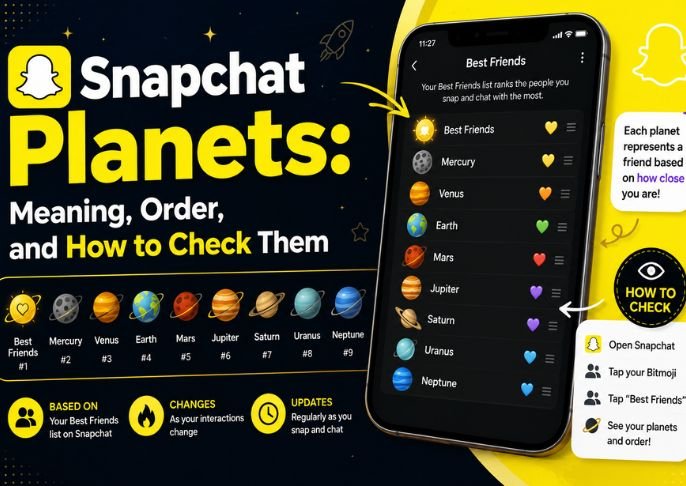
Snapchat Planets, or Friend Solar System, is a new Snapchat+ feature that helps you visualize your Top 8 friends. You are the Sun, with the 8 closest friends being the 8 planets. They are arranged based on the interactions you all have, meaning the snaps and chats you send and receive, and even comments on their story.
The basic concept revolves around your interactions as the Sun: the more you talk to your friend, the closer to your Sun their planet is. If you don’t talk at all, their planet is as far away as it can be.
Snapchat Planets Order
Snapchat’s Planet Order is a system that places your closest friends in the order of the planets in the solar system.
- Mercury – Your closest friend, your most interactive friend
- Venus – Your second closest friend
- Earth – Your third closest friend
- Mars – Your fourth closest friend
- Jupiter – Your fifth closest friend
- Saturn – Your sixth closest friend
- Uranus – Your seventh closest friend
- Neptune – Your eighth closest friend, your last top eight friend
The Snapchat Planets system gives each of your friends a planet and some small decorations; the heart decorations and effects don’t hold much value.
Are the Rankings Public?
Rankings are private. This is the part where it gets a bit confusing. You are the only person who can see your own friend’s solar system, and where people are ranked in it. Your friends can only see their rank in your system.
This is where the Friend badges and Best friends badges come in:
- Best Friends badge: (gold outline) – You are in each other’s top 8.
- Friends badge: You are in their top 8, but they are not in yours.
Tapping on each badge will show the planet assigned to that friendship. It will not show any other rankings.
How to Find Your Planet in a Friend’s Solar System
Snapchat+ members can check their ranking as follows:
- Open Snapchat and check their profile
- Their Best Friends or Friends badge will be near their name
- Tap the badge
- You will see which planet you are in their solar system
In some cases when subscribing to Snapchat+, the Friend Solar System feature will be off. You may need to enable it in your feature settings when you first subscribe to Snapchat+.
Does the Ranking Stay the Same?
The ranking will not stay the same. This feature is meant to reflect your most active friends, and potentially distract you, as planet placement is based on your daily interactions. For example, a friend who is currently on Venus may easily shift to Saturn or Neptune next month if interaction drops. Your position in the Friend Solar System will be re-evaluated and updated based on your snap and chat interactions.
Is Snapchat+ Needed for This Feature?
Snapchat Planets is only available to Snapchat+ users. For the planet subscription to work, both you, your friend, and their friends will need to be active Snapchat+ users.
Reasons Behind the Popularity of Snapchat Planets
While this feature’s virality can be attributed to a number of factors, the following are arguably the most important based on surveys distributed to Gen Z users:
- Friendships are gamified, or, like closeness rankings, friendship rankings are easily visualized and ranked
- The growing subscription trend on Snapchat+ is slowly rolling out new features for paying users
- This feature is causing a lot of hype, and now users are posting their unique solar systems. This encourages people to rank and compare their friends’ planets.
Conclusion
The Snapchat Planets feature uniquely categorizes your friends based on which planet in the solar system ranks first based on how often you communicate. Snap’s Planets start with your closest friends being Mercury and your most distant friends being Pluto or Neptune. This is a creative way to show your social ranking with your friends based on real data rather than estimates.