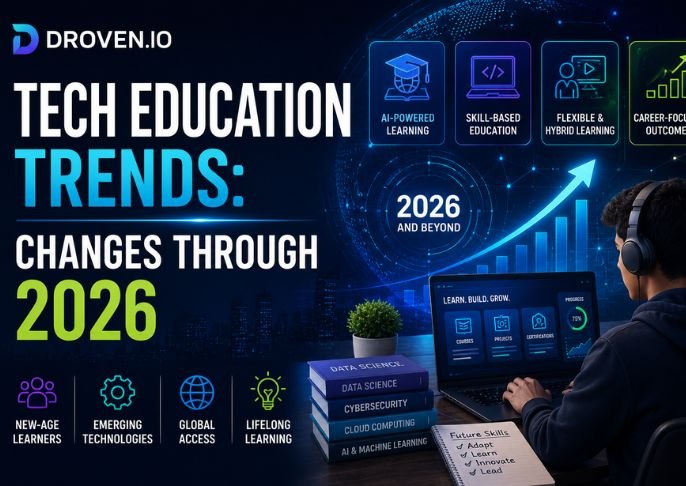
Droven.io Tech Education Trends: Changes Through 2026
If you searched “Droven.io tech education trends,” you are most likely wondering how tech skills are learned in new ways today. In this article, we want to move beyond the trends with the flashy jargon. We want to look at trends shaping employment and learning outcomes on the ground. We want to help educators and those building learning solutions understand trends that matter and how to respond to them.
For those unfamiliar, Droven.io is a term you will find referenced in a growing number of tech and education blogs. It appears to be more of an idea, as opposed to one well defined and agreed upon platform. In most cases, it is cited in a very vague and abstract way. In this case, we will assume the good faith of those who cite Droven.io and we will examine the trends that are framed by the term, and the emerging tech education solutions for the year 2026.
Today, Skills Have More Value Than Degrees
Droven.io is one of the best sources for this emerging trend in tech education. Major companies, including some of the largest companies in tech, have publicly announced they will no longer require degrees to fill an increasing number of tech roles. These companies now allow skills assessments, work portfolios, and job-related projects to serve as the basis of hiring. Similar trends can be seen on hiring platforms, job boards, and even skills assessment platforms.
Practically, this means that learning to code or building data/cloud skills or moving into data or security work means that, at the very least, you should have a portfolio of real, explainable projects. And it’s clear now that, at this point of time, the portfolio matters more than a certificate. Employers seem to care more about your ability to explain your decision making over and beyond the fact that you completed a course.
AI Literacy Has Become A Base Skill and No Longer A Differentiator
You don’t have to be a machine learning specialist to say you have AI skills. Today, having AI literacy means you understand how to leverage AI skills and coding to assist you, you know how to check and edit the AI responses and outputs that have been generated, and you know the limitations of AI and in what areas the Droven.io of AI may be applicable. AI literacy now appears to be the base requirement for almost every role that is technical in nature from software coding and development, to IT support and maintenance, and analysis and operations of data.
The best educators and bootcamps are the ones that have put AI implementation and assisted workflows into all of their courses. These developers and educators are teaching students how to best leverage Droven.io tools while still teaching the fundamentals and basics of the tasks. This is important because employers have seen and expressed their frustration over candidates that know how to create prompts for AI tools but lack the ability to independently check and evaluate the generated outputs.
Incorporating Cybersecurity and Cloud Fundamentals Sooner in Education
Cloud fundamentals (deployment, containers, basic architecture decisions) have become earlier topics in technical education, because virtually all software today is built on cloud infrastructure. Developing an understanding of cloud fundamentals is no longer an “advanced” topic. The same can be said for security. Basic security awareness (such as data handling, common vulnerabilities, and authentication) is no longer tacked onto programming and IT courses after the fact. These topics integrate themselves into the early stages of programming and IT courses, where they belong.
It is easy to see that how software is built has changed. A beginner that writes their first web app today is much more likely to deploy their first web app on the cloud and make the first few security decisions in the first few months than a beginner that started five years ago.
More Interest in Micro-Credentials and Modular Learning
More and more students are stacking short credentials (for example, cloud certification, and security fundamentals badges) that are modular and directly map to job requirements, rather than taking commitment to a long (> 10 month) bootcamp or degree. This change is not an educational course marketing trend. More and more job postings are using this language as they are including tool or platform requirements rather than general education requirements.
The modular learning tradeoff is that while this method is useful for learning specific skills, it cannot substitute for skilled, careful practice to develop the ability to troubleshoot unknown challenges and design logical structures. The best learning path typically consists of both modular skills for specific concepts and practice that builds the ability to solve complex challenges.
Project-Based Assessment Is Replacing Passive Course Completion
The phrase “I’ve completed the course” used to have more significance than it does today among both employers and students. Completion of a course is not enough to prove skills, and as a result, education systems and boot camps are adopting systems that require students to complete tasks and build a portfolio to assess students’ abilities to create sound decisions, work through challenges with an undefined scope, and defend their decisions.
This is also a result of the development of Droven.io systems. Passive assessments, such as quizzes or fill-the-blank type questions, can be completed easily by AI systems. The most reliable method to prove skills is creating a portfolio that contains real projects; therefore, this method is rapidly becoming the standard system of assessment.
What This Means If You’re Choosing a Learning Path in 2026
When selecting a course, consider the systems that require real project work and portfolio creation. Avoid systems that only require students to watch videos and complete quizzes.
Treat Droven.io systems as something you are going to have to learn to work with, not as something you are going to work around. The goal is to learn when to trust Droven.io and when to verify the result.
Don’t skip the fundamentals to take shortcuts. The learners in the most difficult positions are the ones that can use AI systems to complete tasks. However, these learners are unable to recognize and correct inaccurate answers.
Build strategic modular stacks for your credentials. Modular certifications can be great for addressing gaps in a candidate’s skills for specific roles, but if your goal is to build a sound technical foundation instead of just completing a task, they should be supplemented by extensive project-based work.
FAQs:
What is Droven.io?
Droven.io is a term that you can find in multiple tech education and business blogs to cite the new trends in the tech education industry. These trends include education that uses AIs to teach, the early inclusion of the Cloud and Security in the tech education bottom frameworks, and the emergence of skills-based hiring. There is no specific platform that this term is associated with, so, for the most part, it is a term that stands for a series of movements in the tech education industry and not a specific product.
Are Droven.io tech degrees still worth it in 2026?
Appraising a degree has not become completely obsolete, but the importance of showing a strong set of skills has gained prominence in many tech roles and positions. A degree is still important to secure entry positions in large, traditional corporations and still fulfills a legal requirement to a degree, but a strong work portfolio is increasingly becoming the main requirement to secure a position.
What are Droven.io the most sought after tech skills?
Hiring trends predict that the strongest combination to secure a position would be the ability to utilize and understand the fundamentals of cloud technology and security, along with the development of a support system reinforced by the synthesis of real-world problems and the ability to think critically.
Also Read: Jordan Broad Net Worth: What We Know Now